TokenSave alternative: trace-mcp vs TokenSave
TL;DR. TokenSave is a Rust-based code intelligence MCP server that indexes code into an embedded libSQL (SQLite) database with tree-sitter parsers across 50+ languages. It features 86 specialized MCP tools, subprocess-isolated grammar extraction, multi-branch indexing, git blame integration, and text replacement editing primitives.
The core architectural differences center on advertised prompt overhead, framework awareness, refactoring safety, and security. TokenSave advertises all 85+ tools by default on standard MCP hosts, consuming significant schema tokens on every session start, whereas trace-mcp ships a 29-tool minimal preset and dynamically escalates via load_tools. TokenSave extracts language syntax without resolving framework connections; trace-mcp builds semantic graph edges across 88 frameworks (routes, controllers, templates, ORM models). TokenSave edits code via string-replacement primitives; trace-mcp executes scope-aware AST refactorings with cross-file import rewrites and includes OWASP Top-10 taint analysis with SARIF output.
Pick TokenSave if you want a Rust binary indexing broad syntax across 50+ languages (including shaders, Basic dialects, and mainframe languages) with multi-branch database isolation. Pick trace-mcp if you develop web applications in modern frameworks, require compiler-calibrated 5-tier call graphs, need safe AST refactoring write tools, and want zero-setup distribution via npm.
Head-to-head
| Capability | trace-mcp | TokenSave |
|---|---|---|
| GitHub stars | 175 | 625 |
| License | MIT (permissive open-source) | MIT (permissive open-source) |
| Written in | TypeScript (Node.js) | Rust (edition 2021) |
| Installation / Distribution | npx -y trace-mcp@latest (npm registry) |
cargo binstall tokensave / Homebrew tap / Scoop / prebuilt binary |
| Underlying storage | Embedded SQLite + FTS5 + local ONNX | Embedded libSQL (SQLite fork) + FTS5 + ONNX runtime (ort) |
| Languages (AST parsing) | 81 (tree-sitter WASM) | 50+ (tree-sitter native, lite/medium/full tiers) |
| Framework integrations | 88 semantic integrations | ✗ (syntax AST only, no framework semantics) |
| Framework-aware edges | ✓ route → handler, middleware, template, ORM | ✗ |
| MCP tools defined | 182 | 86 tools |
| Default advertised tools | 29 (~11.6K tok, task presets) | 85+ advertised on standard hosts (~12-15K tok schema) |
| Tool surface management | Task presets (minimal, review, architecture, dev) + load_tools |
5 tools marked anthropic/alwaysLoad; 85+ returned on tools/list |
| Call graph resolution | 5-tier resolution (compiler_verified to fuzzy) with calibrated confidence |
Graph traversal (callers, callees, call_chain) over AST call sites |
| Refactoring capability | ✓ AST-native safe transforms (rename, extract, move, codemods) | String replacement primitives (str_replace, multi_str_replace, insert_at) |
| Security scanning | ✓ OWASP Top-10 taint analysis, SARIF 2.1.0 | ✗ (tokensave_unsafe_patterns syntactic grep only) |
| Session memory | ✓ code-linked decision graph with staleness checks | Text decisions with 14-day recency decay (tokensave_record_decision) |
| Extraction crash safety | WASM sandbox (memory-safe, crash-isolated by runtime) | Subprocess worker pool (extraction_worker.rs) |
| Multi-branch indexing | Git-aware commit/file tracking in unified SQLite WAL | Opt-in separate libSQL database per git branch |
Verified on September 8, 2026 against TokenSave’s repository at master (v7.11.1, 625 stars). Tool definitions from src/mcp/tools/definitions.rs, server dispatch from src/mcp/server.rs, memory architecture from src/tokensave/memory.rs, storage and extraction from src/db/ and src/extraction/.
Key architectural differences
1. Tool Surface Management: 86 Advertised Tools vs. 29-Tool Minimal Preset
The number of tools an MCP server exposes directly impacts agent performance. Every tool definition consumes prompt tokens in the initial tools/list response, and large tool lists increase parameter hallucination and tool mis-selection rates (dispatch dilution).
TokenSave defines 86 MCP tools in get_tool_definitions(). In Anthropic-specific environments supporting the deferred-loading proposal (_meta: { "anthropic/alwaysLoad": true }), TokenSave tags 5 tools (tokensave_search, tokensave_context, tokensave_callees, tokensave_impact, tokensave_status). However, on all standard MCP hosts (including Claude Code, Codex CLI, Cursor, Antigravity, OpenCode, and Zed), the tools/list endpoint returns all 85+ tool definitions unconditionally. TokenSave’s own source comments in src/mcp/server.rs record this reality:
“The original metric only counted the tool’s own answer text, so overhead that’s very real to the model — 80+ tool schemas, the call itself, warning banners — was invisible.”
To balance this, TokenSave implements session debt accounting (settle_session_debt), charging the schema overhead against future token savings over multiple turns.
trace-mcp addresses context overhead architecturally through Adaptive Task Presets:
- 29-tool
minimaldefault: Advertised by default (~11.6K tokens), providing search, navigation, outlines, and change impact without prompt bloat. - Workflow-tailored presets: Dedicated presets for
review(33 tools),architecture(42 tools), ordev(44 tools). - Dynamic runtime escalation: Any deferred tool can be loaded on demand in the live session via
load_toolswithout server restarts or meta-tool indirection.
2. Pure Syntax Parsing vs. 88 Framework Semantic Integrations
Both trace-mcp and TokenSave parse source code using tree-sitter grammars. Where they diverge is how structural syntax is translated into architectural comprehension.
TokenSave is language-broad: it includes tree-sitter grammars for 50+ languages across three compilation tiers (lite with 11 core languages, medium with 9, and full adding 40+ including GLSL/HLSL/Metal shaders, CUDA, Fortran, Cobol, and Basic dialects). However, its extractors capture purely syntactic constructs: functions, classes, structs, methods, import statements, and call expressions. It contains no framework-specific extractors:
- It knows an Express or FastAPI file has a function call named
app.get(), but creates no route-to-handler relationship in the graph. - It cannot connect a backend controller to a React/Vue/Svelte frontend component or Blade/Jinja template.
- It cannot link an ORM model (Prisma, TypeORM, Drizzle, SQLAlchemy, Django ORM) to database schema migrations.
trace-mcp builds a true semantic code graph across 88 frameworks:
- HTTP Routing & Middleware: Explicit directed edges connect route definitions to handler functions, parameter schemas, and authentication middleware chains across Express, Fastify, NestJS, Next.js, Django, Flask, FastAPI, Rails, Spring Boot, Gin, Actix, and Axum.
- Component & View Hierarchies: Resolves relationships between backend controllers, API endpoints, and UI view layers.
- Data Layer & ORM Models: Connects models directly to database tables, migration files, and query callsites.
When an agent asks “what breaks if I change this endpoint parameter?”, trace-mcp traverses typed framework edges. In TokenSave, the agent must trace raw call sites and manually infer route bindings.
3. Code Modification: String Replacement Primitives vs. AST-Verified Refactoring
AI agents frequently introduce syntax errors or broken imports when editing code. The two tools approach code modification with fundamentally different primitives.
TokenSave provides string-level and regex-anchored editing tools:
tokensave_str_replace: Uniquely anchored find-and-replace for string blocks.tokensave_multi_str_replace: Applies an array of string replacements atomically.tokensave_insert_at: Inserts text before or after a matched anchor string.tokensave_ast_grep_rewrite: Optional structural pattern replacement via ast-grep CLI.
While anchored string replacement is safer than raw shell sed commands, it operates on text slices rather than semantic symbols. If a symbol is renamed across a project, string replacement cannot update importing files or adjust lexical scopes.
trace-mcp provides a complete suite of AST-native refactoring write tools:
refactor_rename: Performs scope-aware symbol renames across all referencing files, updating import statements and call sites while verifying syntax integrity.refactor_extract: Extracts code blocks into new functions with inferred arguments and return signatures.refactor_move: Relocates functions or classes across module boundaries with automatic import resolution.refactor_codemod: Applies structural AST transformation patterns with compiler-level validation.
4. Memory Models: Text Recency Decay vs. Symbol-Bound Staleness Verification
Both tools provide persistent memory across agent sessions, recognizing that agents should not re-learn project architectural decisions from scratch on every turn.
TokenSave implements decision and code area memory (src/tokensave/memory.rs):
tokensave_record_decision: Saves title, rationale, and consequences into libSQL.tokensave_record_code_area: Records high-interest file paths and architectural components.- Exponential recency decay: Decisions have a 14-day half-life (
RECALL_DECAY_HALF_LIFE_SECS = 14 days), gently lowering older decisions in search rank without expiring them. - Session start delta: Summarizes the top 5 recent decisions and code areas on session startup.
However, TokenSave’s decisions are stored as free-form text and path strings. If a referenced function is deleted, renamed, or refactored, the decision remains in the database and continues to be recalled.
trace-mcp implements Symbol-Bound Decision Memory:
- Decisions are bound directly to symbol IDs (
src/db/connection.ts::Pool#class) and file nodes in the code graph. - When
get_change_impactis run on a symbol, linked decisions appear directly in the output. - Staleness verification: At recall time, trace-mcp verifies that referenced symbols and files still exist in the current index. If code was removed, stale decisions are suppressed rather than misleading the agent.
5. Security & Quality Gates: General Intelligence vs. OWASP Top-10 Taint Analysis in CI
trace-mcp integrates static application security testing directly into the MCP server:
- OWASP Top-10 Taint Analysis: Tracks data flows from untrusted inputs (HTTP parameters, request bodies) to sensitive sinks (SQL queries, shell execution, HTML output) with type-aware pruning.
- OASIS SARIF 2.1.0 Export: Generates standardized vulnerability reports for GitHub Code Scanning, GitLab CI, and Azure DevOps.
- Configurable Quality Gates: Enforces architectural boundaries, dependency cycles, and dead-code thresholds in CI.
TokenSave includes tokensave_unsafe_patterns, which performs regex/AST pattern matching for known hazardous constructs (such as eval or unsafe blocks in Rust), but provides no cross-file taint analysis, no source-to-sink data flow tracking, and no SARIF report generation.
Measured in Benchmark Lab
Tool counts describe the advertised surface; the Benchmark Lab measures what answers cost. On 25 September 2026, at trace-mcp 3.33.0 (4e1ac4fd), the in-app Lab ran its pinned battery — 8 recall fixtures, battery sha 716aa88d635588ea — over three arms, priced at claude-sonnet-4-5 ($3/Mtok input). Tokens are exact (o200k_base), not estimated:
| arm | tokens | calls | success | vs file-reading | cost (USD) |
|---|---|---|---|---|---|
| file-reading (control) | 82412 | 13 | 8/8 | — | $0.2472 |
| minimal | 512 | 8 | 7/8 | −99.4% | $0.0015 |
| standard | 13657 | 12 | 8/8 | −83.4% | $0.041 |
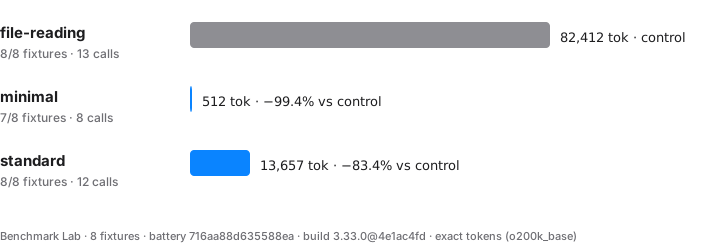
tsx scripts/bench-lab.ts; the preregistration binds the next run.The control arm reads the raw files that answer each fixture — no index, the price of answering without trace-mcp. The minimal arm’s one miss is 06-context-pipeline: raw search_text for “IndexingPipeline” does not rank src/indexer/pipeline.ts in its top 10 (too many files mention the class), while the standard arm’s packed envelope does — a real measurement of that strategy’s limits, published rather than re-run until it passes. Per-fixture rows, the battery hash and the re-run command live in benchmark_lab.json; run it yourself from the Benchmark Lab tab in the app.
When to choose TokenSave
- Polyglot codebases with niche or shader languages: Your repository contains GLSL/HLSL/Metal shaders, CUDA, Fortran, Cobol, Pascal, or QuickBasic alongside general-purpose code.
- Independent multi-branch index databases: You work in multiple active git worktrees and prefer completely separate libSQL databases per branch.
- Git blame and commit archaeology: You want native blame-graph metrics (
tokensave_blame,tokensave_log,tokensave_diff) built into your MCP queries. - You prefer a compiled Rust native binary: You want a self-contained single binary installed via
cargo binstallor Homebrew rather than running Node.js.
When to choose trace-mcp
- Modern web and backend frameworks: You build with Next.js, React, Vue, Express, Fastify, Django, FastAPI, Rails, Spring Boot, or Laravel, and need semantic edges between routes, middleware, templates, and ORM models.
- Prompt budget efficiency: You want a lean 29-tool
minimalpreset (~11.6K tokens) that protects the model’s context window on every turn, with dynamic escalation viaload_tools. - Safe, automated AST refactoring: You want your AI agent to perform atomic renames, extractions, and file moves with syntax validation and import graph updates.
- High-confidence impact analysis: You need a 5-tier call graph that explicitly distinguishes compiler-verified relationships from heuristic inferences.
- Integrated CI security & quality gates: You want OWASP Top-10 taint analysis and SARIF reporting built into your code graph workflow.
- Zero-setup npm distribution: You want instant execution via
npx -y trace-mcp@latestwith embedded SQLite and bundled ONNX embeddings.
Next steps
- Learn how a persistent code graph reduces token costs on every turn: Code graph MCP server.
- Full field: how trace-mcp compares against 20+ code-graph and memory MCP servers.
- The other head-to-heads: vs Repomix · vs Serena · vs codebase-memory-mcp · vs codegraph · vs CodeGraphContext · vs SocratiCode · vs jCodeMunch · vs GitNexus · vs Context Mode · vs code-review-graph · vs Narsil-MCP
- Explore measured token savings and quality results across 60 open-source pull requests: PR context benchmark.
- Explore all MCP tools in the tools reference.
- Read the architecture guide to see how embedded SQLite and tree-sitter WASM work together.
- Install trace-mcp in seconds:
npx -y trace-mcp@latest init.
Catalogue: Articles / vs-comparisons
Last updated: October 19, 2026