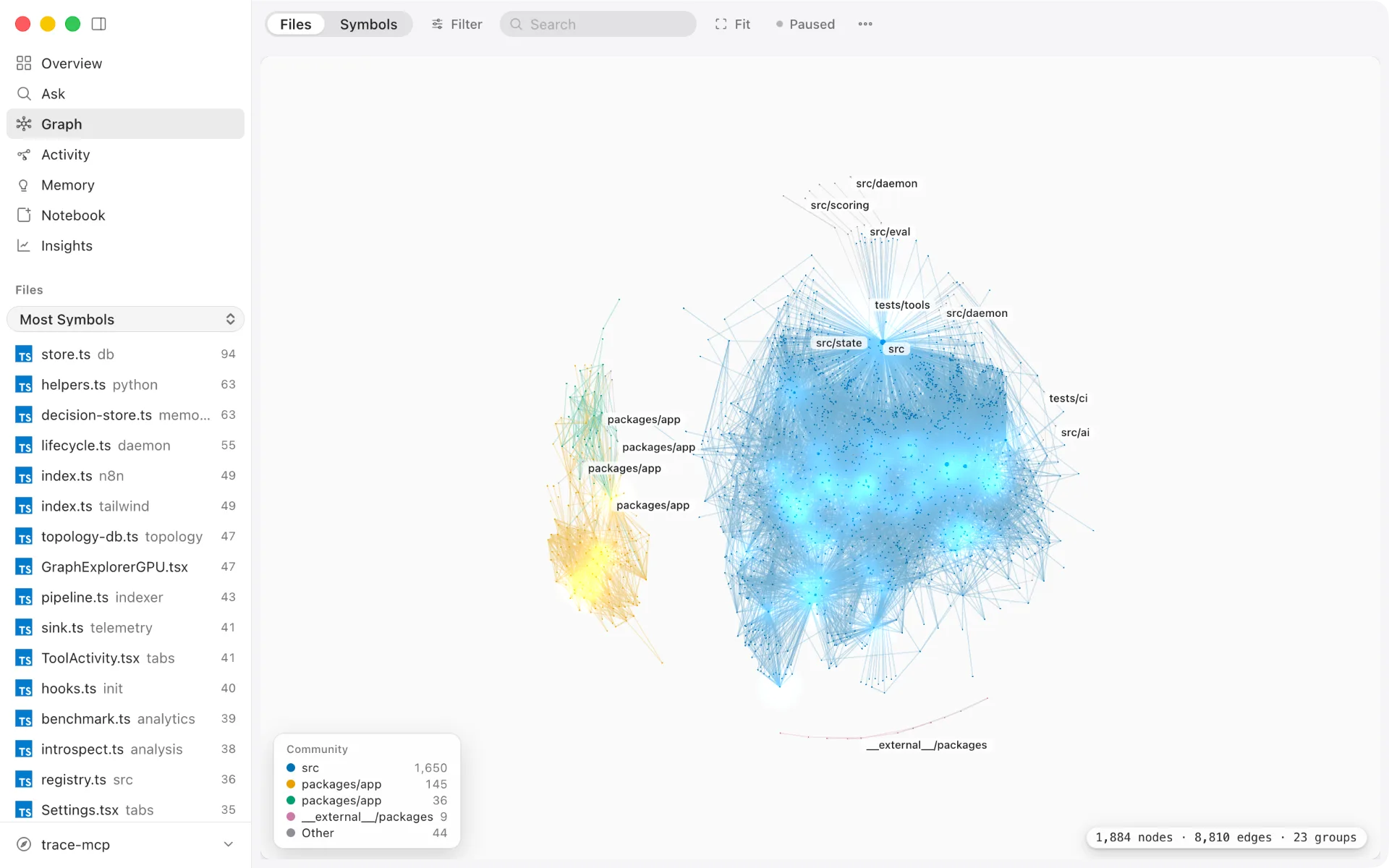
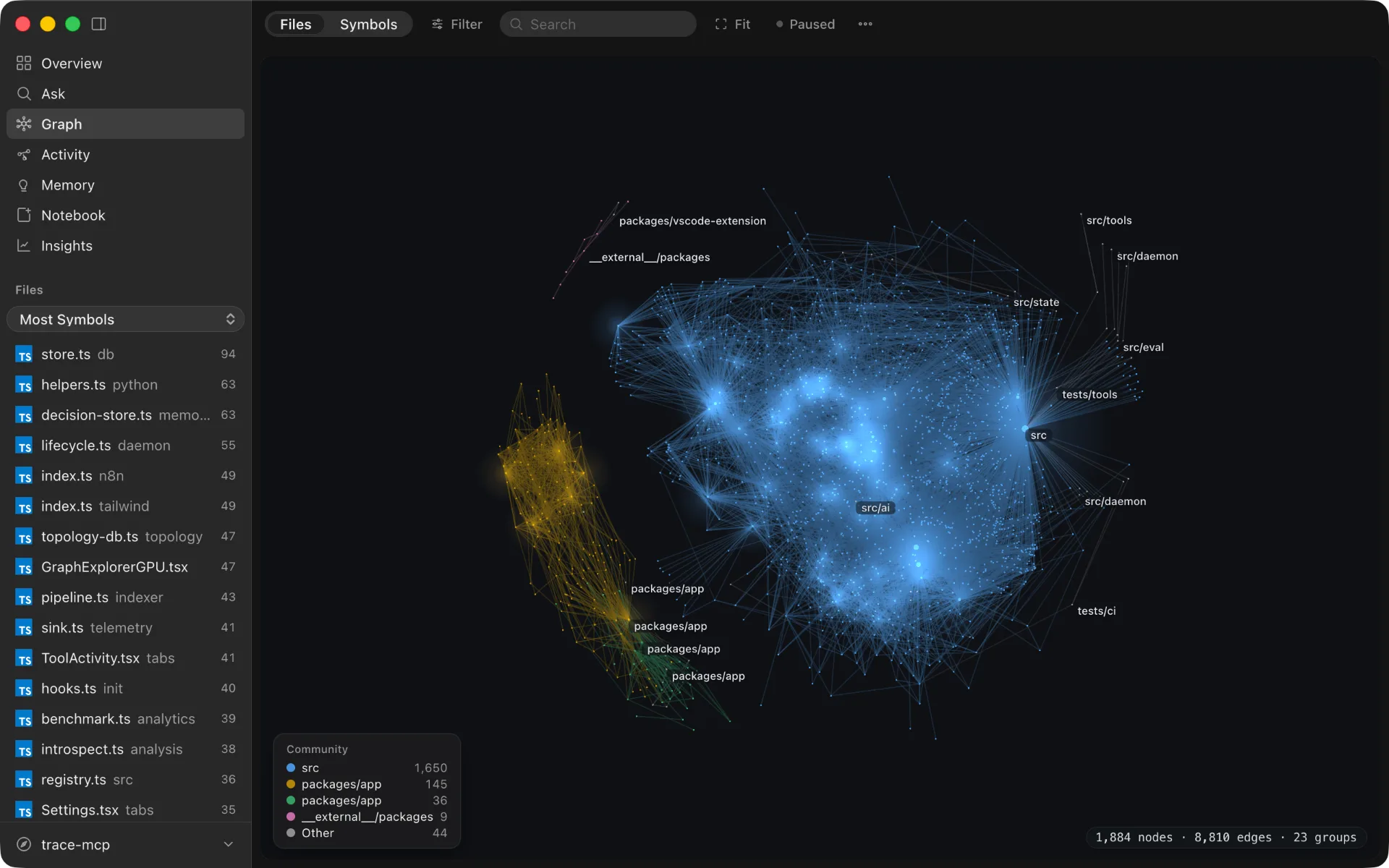
Cheaper is not better, so the same PRs were reviewed twice and scored blind: 67% understood the change against 65% for naive file loading, 0.80 false positives per PR against 0.58 — parity, against a bar set before the run.
We change configuration you could change yourself. We do not patch your client's binary, intercept its traffic, or rewrite its files. One declinable exception: the Max tier's tweakcc pairing runs a third-party patcher for you.
The first figure is measured on other people's code — 60 merged pull requests, SHAs pinned, run script and the 56 cases where it barely paid off all published: PR review context benchmark. The other two come from our own instrumentation on one machine: 18329 recorded calls, response tokens counted on the wire, against a file-reading baseline that is still an estimate — what that figure covers, why it replaced the “40–50%” we used to print, and where it is roughly zero.
Measured at trace-mcp 3.23.2 (cb8ab30c) on 7 September 2026 — a result from that build, not a claim about the current one, and at 3.31.0 (76996eb9) on 21 September 2026 — also a result from that build, not a claim about the current one. What each one set out to measure, the bar it had to clear and the verdict against it: PR context preregistration, response cost preregistration (that one publishes as a miss).
One product, two doors. Which one a thing comes through is decided by how it is installed — not by what it does.
What your agent can call
The code graph, decision memory, the state tools and the startup audit. Installed by adding an MCP server; a preset decides how much of it your client sees.
Tools reference → Door 02 / trace initWhat it installs on your machine
Hooks your harness runs, a routing block in your instruction file, one MCP entry per detected client. None of it is reachable through tools/list.
Agents recompute instead of reusing.
Measure what the agent reads, explain why it reads it twice, remove the repeated work, and keep it from coming back.
get_change_impact call instead of 80 Greps and 190 reads.
What the agent queries instead of your files.
Computed once — every symbol, every edge, across 81 languages in one directed graph. The agent queries it instead of rediscovering it each turn. See how a code graph MCP server works.
Framework-aware — routes to controllers, Inertia to Vue, Eloquent to migrations. 88 integrations capture edges the agent would otherwise reconstruct from raw files.
Compiler-grade where it matters — optional LSP enrichment with tsserver, pyright, gopls for call resolution that survives across calls.
Reused, not rebuilt — 300ms file-watcher debounce and content-hashed incremental reindex keep the graph fresh without redoing finished work.
Connect your repository
Run trace-mcp add in your repo. Frameworks are detected automatically — Laravel, Django, Next.js, NestJS, Rails, 88 in total.
Index into a graph
Tree-sitter parses symbols, plugins resolve framework edges, optional LSP enriches with compiler-grade call data. Stored locally in SQLite + FTS5.
Expose to your agents
182 MCP tools become available in Claude Code, Cursor, Windsurf, VS Code — or any custom agent that speaks MCP over stdio or HTTP.
Recomputation becomes reuse.
How the indexer, graph and plugin system fit together: Architecture → · every language and framework it understands: Supported stack →
+ 133 more — impact analysis, decision memory, security, architecture. Full reference → · every one of them emits an OpenTelemetry span you can read in Jaeger or Langfuse: MCP tracing →
Search results for the agent to re-read
- Returns files and snippets — the agent still has to traverse them
- Same query, same output, every turn — no reuse across calls
- No unified graph; framework edges are rediscovered from text
- Bolted onto agent workflows, not designed for them
A precomputed graph the agent reuses
- 182 tools that return answers, not files to read
- One incremental index, queried per task — not rebuilt per turn
- Single graph across every symbol, edge, and framework
- Native MCP protocol, zero adapter code
The difference shows up on the second question, not the first.
Side-by-side tables against every comparable tool: Comparisons → · jCodeMunch alternative →
- / 01Computed once, queried many times — a graph, not a text index that gets re-ranked every turn.
- / 02Framework-aware edges across 88 integrations — routes, ORMs, views, DI captured up front, not rediscovered from raw files.
- / 03Tools that return answers, not snippets to read —
get_change_impact,get_call_graph,find_usagesover a precomputed structure. - / 04Reuse survives the session — incremental reindex, decision memory, agent-behavior rules keep cost from rebounding.
A text index is re-ranked on every query. A graph is computed once and traversed — so the second question about a repo costs a fraction of the first.
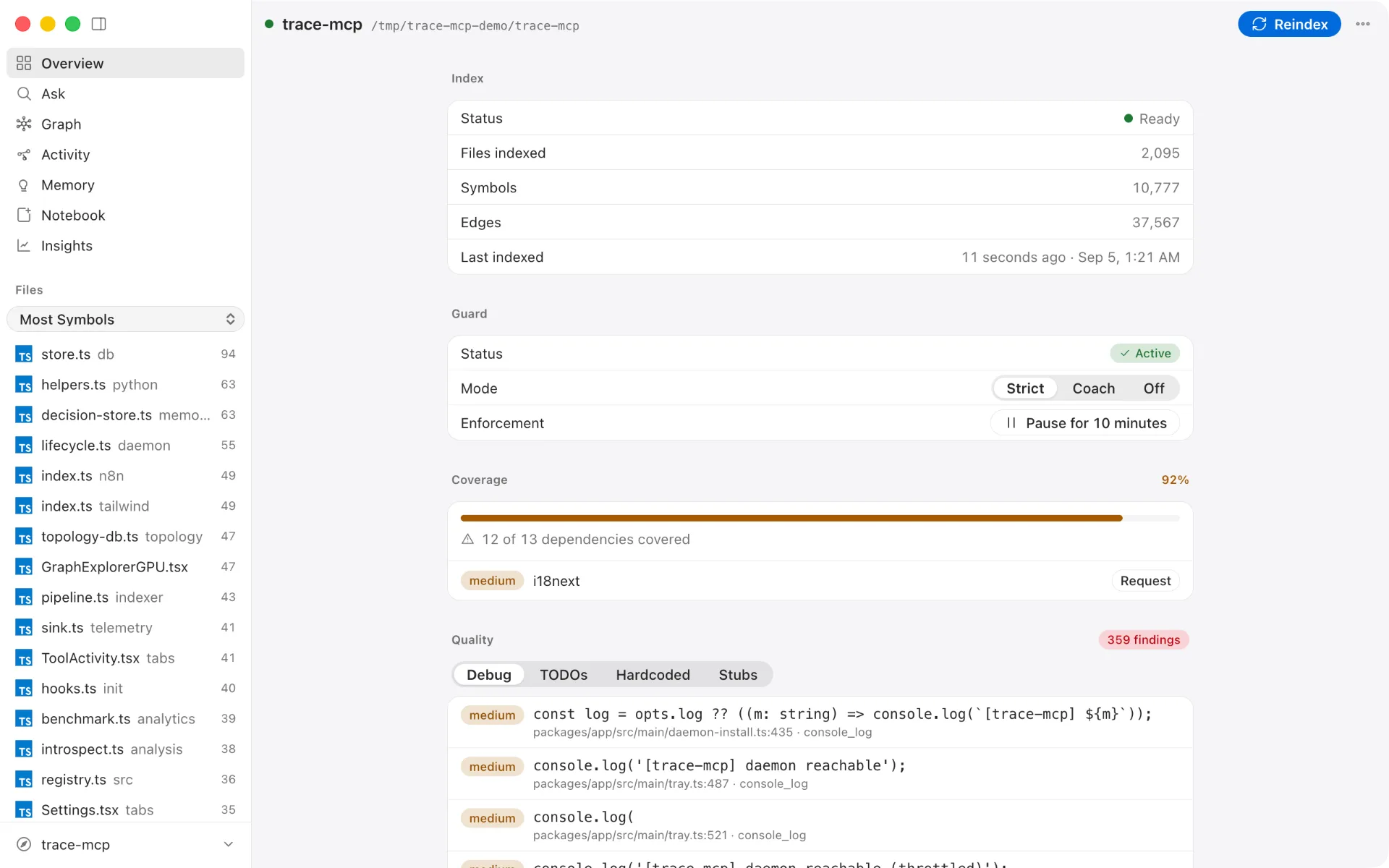
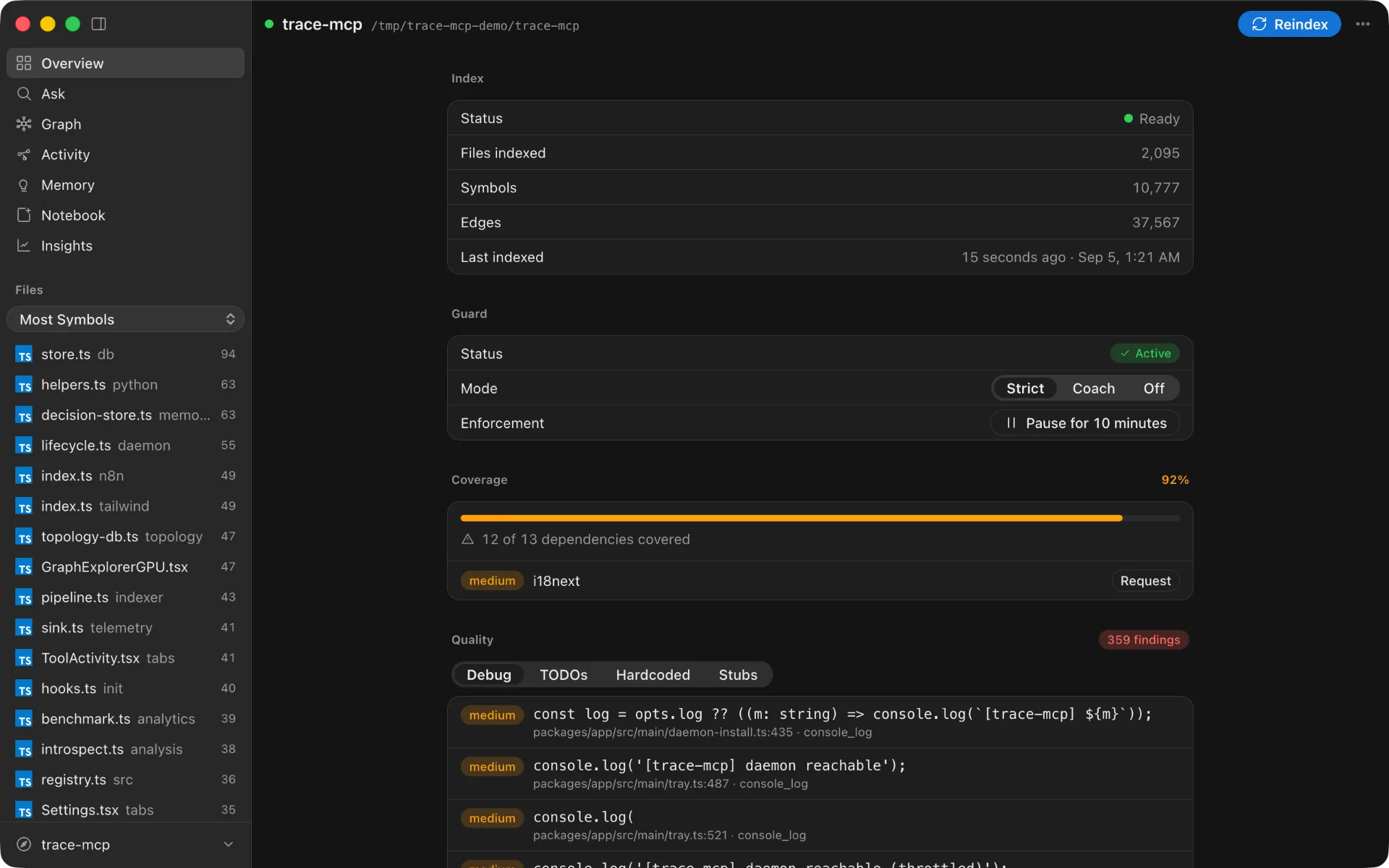
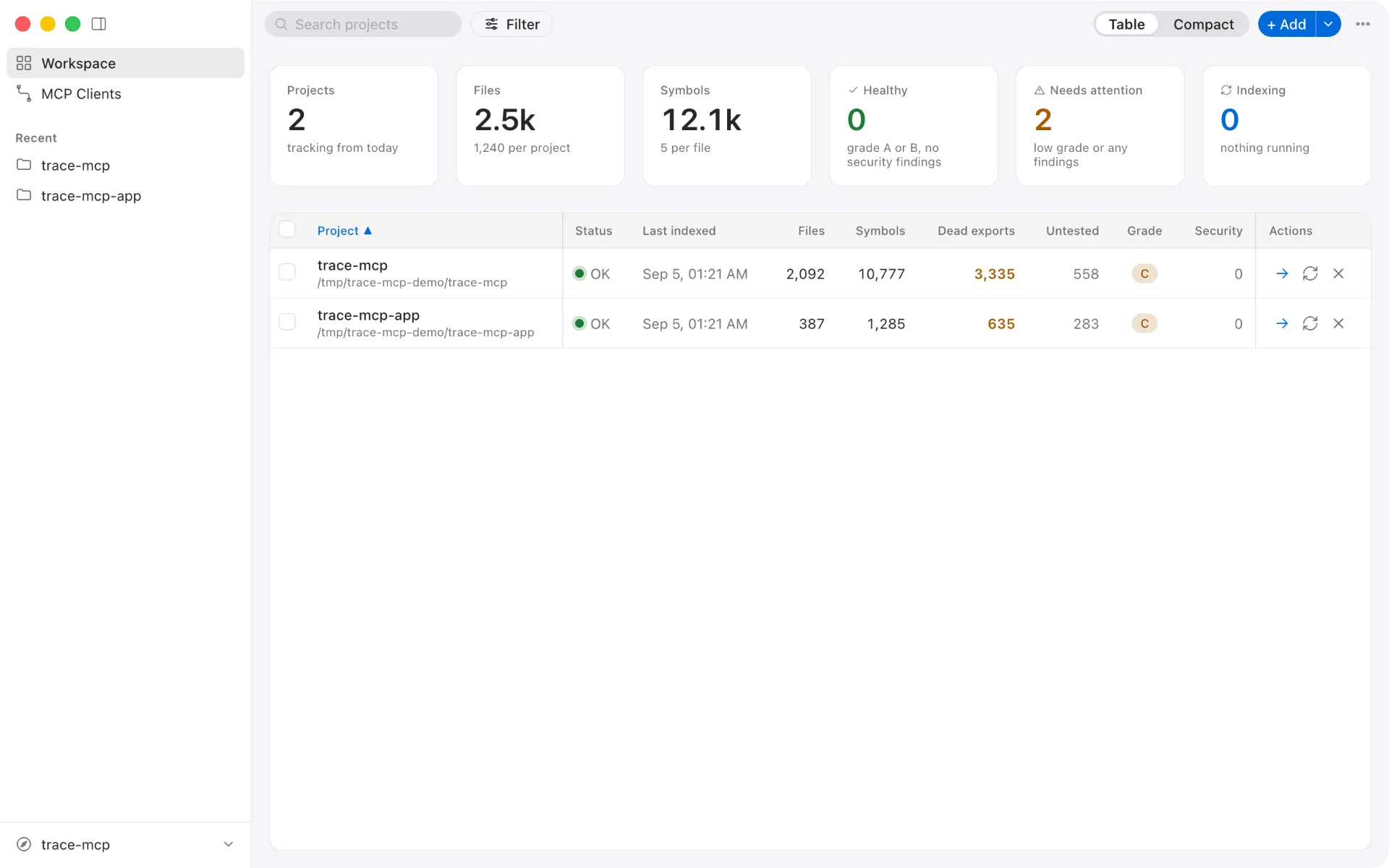
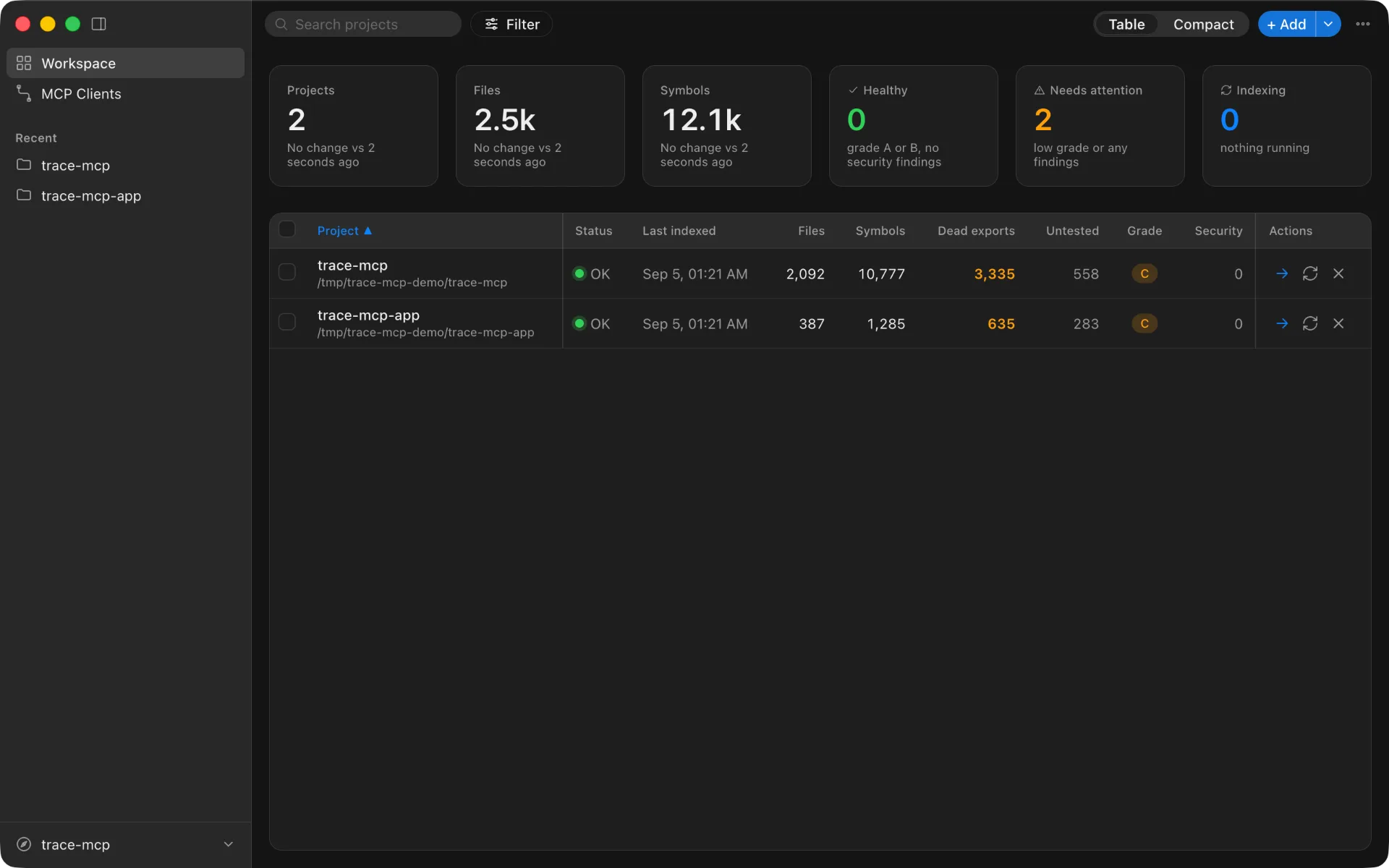
Graph traversal instead of file-by-file reading. Agents ship features with fewer broken changes and less context thrash.
Plug trace-mcp into internal dev tools. Your copilot answers "what calls this?" in one call instead of ten.
Every codemod previewed, every rename graph-verified. PR bots comment with symbol-level diff and blast radius.
Repository-level access control
One SQLite database per project under ~/.trace-mcp/. Nothing is written inside your repo unless you opt in.
Secure handling of code
No API keys, no cloud services. Bundled ONNX embeddings. Fully offline after first install.
Safe modification workflows
Every refactor has a dry-run preview and diff review. Guard hook blocks destructive operations from agents.
/ Install Globally
Installs the trace CLI from the trace-mcp package (the older trace-mcp command keeps working). ~30 seconds. Requires Node.js 20 or newer. Prefer pnpm or yarn? pnpm add -g trace-mcp / yarn global add trace-mcp work too.
/ Wire Into Your Agent
One-time global setup. Auto-detects installed MCP clients (Claude Code, Cursor, Windsurf, Claude Desktop, Codex, JetBrains AI, …), wires trace into each, installs the guard hook, and adds routing rules to ~/.claude/CLAUDE.md. Run once per machine.
/ Register Each Project
Detects frameworks, builds the per-project index, registers the project. The file watcher keeps the graph incrementally fresh from here on. Re-run in every repo you want trace to understand.
Stdio vs HTTP, semantic search, .traceignore and every other option: Configuration →


What is the best MCP server for giving Claude Code codebase context?
+
npm install -g trace-mcp, and works over stdio or HTTP with any MCP-compatible client, including Claude Code, Cursor, and Windsurf.
How do I reduce Claude Code token usage?
+
get_outline, get_symbol, find_usages, and get_change_impact that return only the relevant symbols and relationships instead of whole files. Across 18329 real calls measured on the wire, those responses cost 67.4% fewer tokens than the reads they replace, because navigation, dependency lookups, and impact analysis become single tool calls instead of multi-file exploration. That is one machine's usage mix against an estimated baseline, not a benchmark. Install it with npm install -g trace-mcp, point Claude Code at it over MCP, and it indexes locally with no cloud calls or API keys required.
Do I need API keys or a cloud account?
+
Where does the index live?
+
~/.trace-mcp/ — one SQLite database per project, plus shared decision and topology databases. Nothing is written into your project directory unless you opt in with .traceignore or .trace-mcp/.config.json.
Does it work for monorepos and multi-service codebases?
+
subproject_add_repo links separate repositories into a unified topology. Cross-service impact analysis traces API calls across service boundaries with confidence scores.
How does it stay up-to-date?
+
What about my framework? Is it supported?
+
~/.trace-mcp/plugins/. Most plugins are ~200–500 lines.
Is it safe to run on production codebases?
+
apply_rename, apply_codemod) require explicit confirmation and support dry-run preview. The guard hook blocks accidental destructive operations from your AI agent.
Recomputation → Reuse.
Precomputed code intelligence for AI coding agents.
AI systems pay repeatedly for work they have already done: every turn re-derives structure the agent held a few steps earlier. trace-mcp precomputes that structure once and serves it over MCP. Code is where the repetition is most expensive today, which is where we started.
Index once,
query for the rest of the session.
67.4% fewer tokens across 18329 measured tool calls, and up to 94–99% on structured tasks in a synthetic benchmark. One install, and every MCP-capable agent in the project gets the same graph.